Personal Training vs Group Fitness
A Straight-Talking Guide to Help You Choose What Actually Works for You
Walk into almost any gym and you will find two worlds running side by side. In one corner, someone is working one-on-one with a trainer who is watching every rep, adjusting their form, and pushing them a little harder than they would push themselves. In the other, a room full of people are moving together through a spin class or a HIIT session, feeding off each other’s energy.
Both are popular. Both can produce results. But they are not the same, and they are definitely not right for everyone. So if you have been trying to decide between personal training and group fitness, this guide will give you a clear and honest answer — no fluff, just the things that actually matter when you are trying to get fit.
What Is Personal Training?
Personal training means working directly with a qualified fitness professional — either in a gym, in your home, or outdoors — on a programme designed specifically for you. Your trainer assesses where you are starting from, understands what you want to achieve, and builds a plan around those two things.
Sessions are typically 45 minutes to an hour. Your trainer watches how you move, corrects your technique in real time, and adjusts the plan as you get stronger or your goals shift. There is no standard template. It is all built around you.
The cost is higher than a gym class — usually somewhere between $53 and $134 or more per session depending on location and experience — but what you are paying for is undivided attention and a plan that does not ask you to fit into someone else’s workout.
What Is Group Fitness?
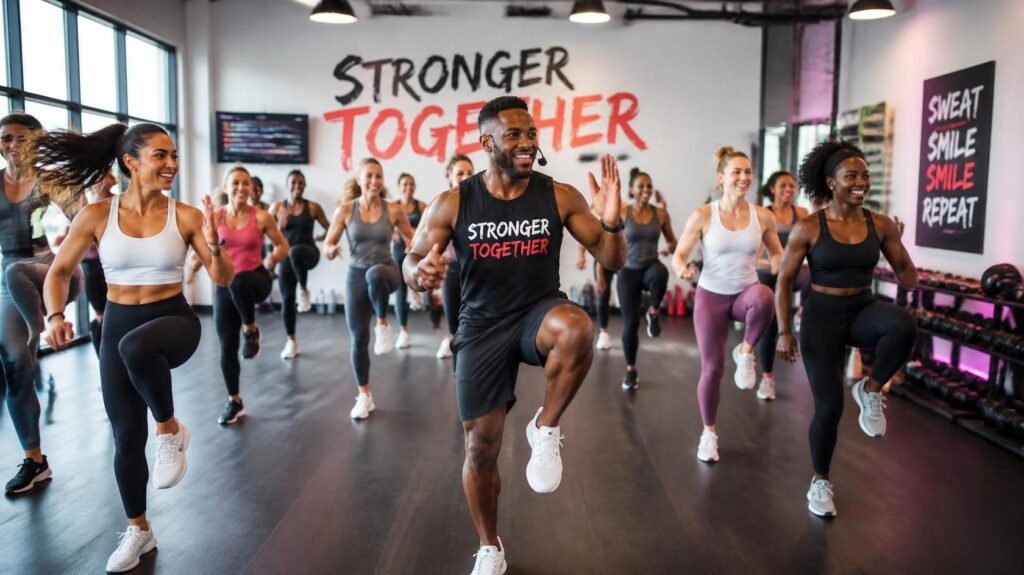
Group fitness covers everything from spinning and yoga to boxing circuits, Pilates, bootcamp sessions, and dance-based workouts. The format is simple: a qualified instructor leads a class, and everyone in the room follows the same session at roughly the same time.
Classes usually run for 45 to 60 minutes and are scheduled at fixed times. Cost is significantly lower than personal training — often between $10 and $40 per class, with monthly memberships bringing the price down further.
The social energy of a room full of people working hard together is something personal training simply cannot replicate. For many people, that shared atmosphere is the main reason they show up consistently.
Personal Training vs Group Fitness: Side-by-Side Comparison
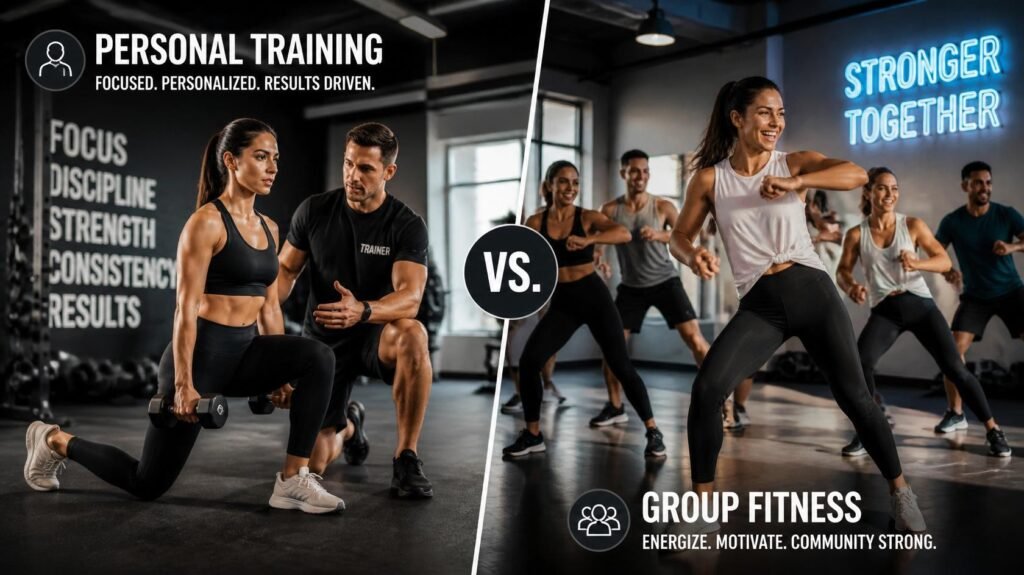
Before going deeper, here is a quick visual breakdown of how the two options compare across the factors that matter most:
| Factor | Personal Training | Group Fitness |
| Personalisation | Fully tailored to you | Same workout for everyone |
| Cost | Higher ($53–$134+ per session) | Lower ($10–$40 per class) |
| Accountability | Direct — trainer notices if you skip | Social — group keeps you going |
| Progress Speed | Faster for specific goals | Steady, general improvement |
| Injury Safety | Form is closely monitored | Less individual attention |
| Social Element | One-on-one, little community | High — built-in group energy |
| Flexibility | Schedule around your life | Fixed class times |
| Best For | Targeted, measurable goals | Consistency & motivation |
The Real Advantages of Personal Training
Everything Is Built Around You
This is the single biggest reason people choose personal training. If you have a specific goal — losing a set amount of weight, recovering from a knee injury, training for a marathon, or building muscle in particular areas — a personal trainer can structure every session around that goal. Group classes cannot do this, because they are designed to serve a room full of people with different starting points and different objectives.
Your Technique Is Monitored Closely
Poor form does not just slow your progress — it can get you hurt. A personal trainer watches how you move throughout the session and corrects things before they become habits or injuries. This matters especially if you are new to exercise, returning after an injury, or doing complex movements like deadlifts, squats, or Olympic lifts.
Progress Happens Faster
Because the programme is targeted and constantly adjusted to where you are, results tend to come more quickly for specific goals. There is no wasted time doing exercises that do not serve your objective, and the intensity is calibrated to push you appropriately without overdoing it.
It Removes the Guesswork
A lot of people spend years going to the gym without knowing whether what they are doing is right for their goals. A personal trainer removes that uncertainty. You walk in knowing exactly what you are doing that day and why — and you leave knowing it was the right session for where you want to go.
The Real Advantages of Group Fitness
The Energy in the Room Is Genuinely Motivating
There is something that happens when you are surrounded by other people working hard at the same time. It is harder to quietly stop when the person next to you is still going. Group fitness creates a kind of collective momentum that is very difficult to manufacture on your own — or even with a trainer. For people who struggle with motivation or find solo workouts boring, this energy can make all the difference.
It Costs Significantly Less
The economics are hard to argue with. A monthly group fitness membership can be a fraction of the cost of even a handful of personal training sessions. If budget is a genuine concern, group fitness lets you exercise consistently without the financial pressure — and consistency, as we will discuss, is one of the most important factors in actually getting results.
There Is Real Social Value
Regular group fitness classes build community. You start recognising the same faces, picking a favourite spot in the room, and feeling like part of something. That social connection has been shown to improve both adherence to exercise programmes and overall wellbeing. People who feel connected to a class tend to keep coming back.
Variety Keeps Things Interesting
Most fitness facilities offer a broad menu of group classes — cycling, strength, yoga, HIIT, combat-based sessions, dance. You can try different formats, find what you genuinely enjoy, and rotate between styles to keep things fresh. Variety also provides a degree of cross-training benefit, working your body in different ways throughout the week.
Which One Actually Gets Better Results?
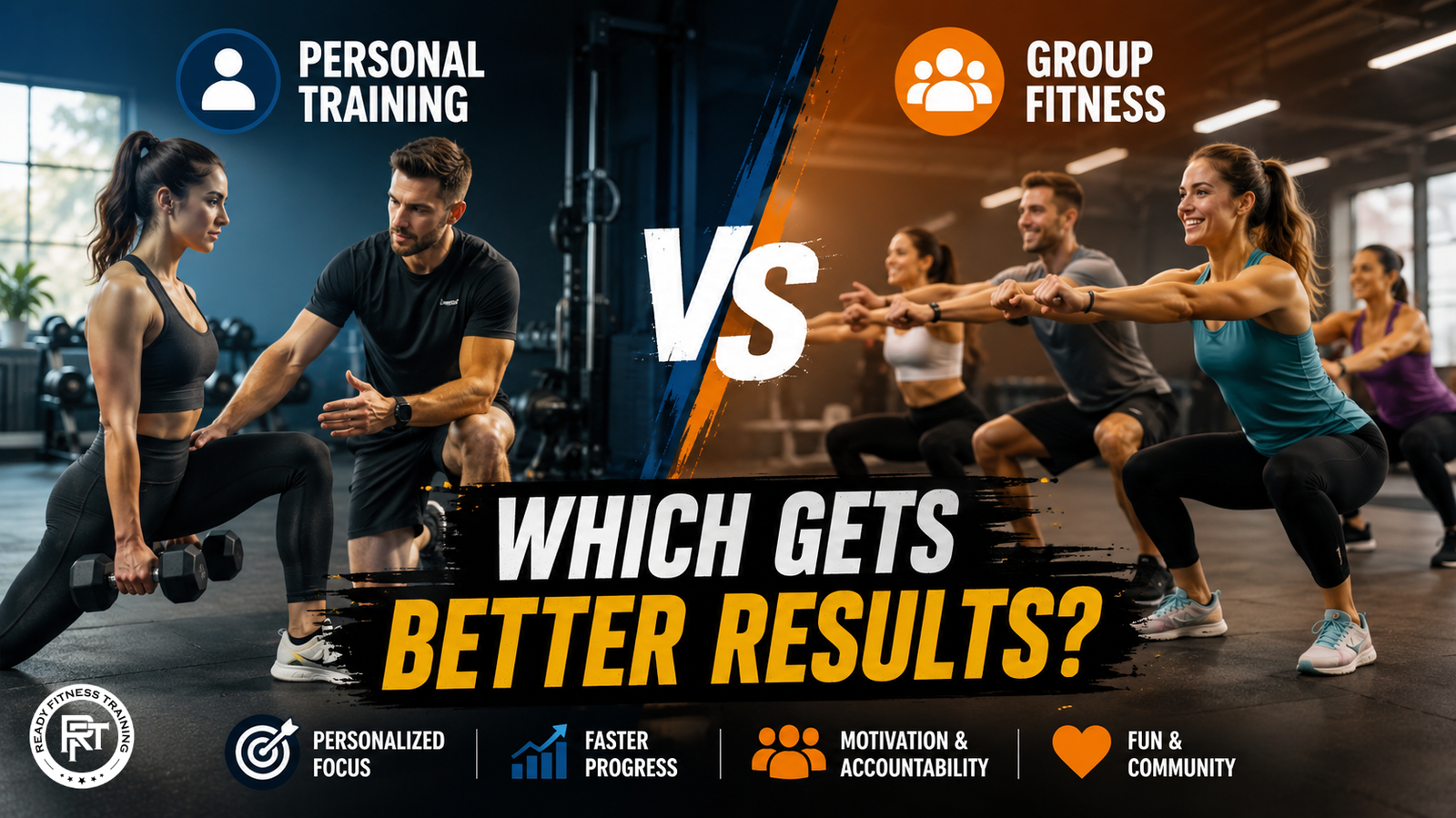
The honest answer is: it depends entirely on what results you are after.
Personal training wins when your goals are specific and measurable. If you are trying to rehabilitate an injury, build strength in particular muscle groups, lose a precise amount of body fat, or prepare for a specific athletic event, the tailored approach of one-on-one training will get you there more efficiently.
Group fitness wins when consistency and enjoyment are your primary challenge. If you know you need to just keep moving, build a healthy habit, and stop finding excuses to skip the gym, a class that you actually look forward to will serve you better than a perfect programme you never stick to.
The research on this is fairly clear: the exercise you actually do consistently produces better results than the theoretically superior option you avoid. Motivation and adherence matter as much as programme design.
For many people, the answer is not either/or. A hybrid approach — using group classes for energy and consistency, and occasional personal training sessions to check form, set a new programme, or push through a plateau — can give you the best of both worlds.
Who Should Choose Personal Training?
Personal training is likely the better fit if you:
● Have a very specific goal that requires a targeted programme
● Are recovering from an injury or managing a physical condition
● Are new to exercise and want to learn proper technique from the start
● Have tried group fitness and found it does not move you toward your particular goal
● Have the budget for it and prefer a more private, focused environment
Who Should Choose Group Fitness?
Group fitness is likely the better fit if you:
● Thrive on social energy and find solo exercise demotivating
● Want to build a consistent exercise habit without high costs
● Enjoy trying different workout styles and keeping things varied
● Are generally healthy with no specific injury or condition to manage
● Are already fairly active and looking for an enjoyable way to stay that way
Frequently Asked Questions
Is personal training worth the extra cost?
For people with specific goals — weight loss, strength building, injury rehabilitation, or sport preparation — yes, it can be very much worth it. The efficiency of a tailored programme often means faster results, which means fewer total sessions to achieve what you are after. That said, if your primary need is simply to exercise regularly and build a healthy habit, group fitness will serve you well at a fraction of the price.
Can a beginner start with group fitness or is it too intense?
Most group fitness formats welcome beginners and allow modifications. A good instructor will offer lower-intensity variations for those who need them. That said, beginners who are particularly concerned about injury or unsure about their movement patterns may benefit from a few personal training sessions first to build a solid foundation before joining group classes.
How many personal training sessions do I need to see results?
This varies significantly depending on your starting point and goals. Most people notice meaningful improvements within six to twelve sessions if they are also exercising between appointments. For more significant transformations, a consistent programme over three to six months is more realistic.
Can I do both personal training and group fitness at the same time?
Absolutely, and many people find this the most effective approach. Group classes provide regular movement and social motivation, while occasional personal training sessions ensure your technique is sound and your programme is progressing in the right direction.
What type of group fitness class is best for weight loss?
High-intensity interval training (HIIT), cycling, and circuit-style classes tend to burn the most calories per session. However, the best class for weight loss is ultimately the one you enjoy enough to attend consistently — because frequency matters more than format.
The Bottom Line
Personal training and group fitness are not in competition — they solve different problems for different people. Personal training offers precision and accountability when you have a clear goal that needs a structured path. Group fitness offers energy, community, and accessibility when what you really need is to keep showing up.
If you are weighing up the two, start by asking yourself one honest question: what has actually stopped you from getting the results you want until now? If the answer is that you have not known what to do, personal training is your answer. If the answer is that you know what to do but you do not do it consistently, group fitness might change that.
Either way, the best option is the one you will actually stick with — and the one that fits your life right now.
This article is for informational purposes only. Individual fitness results vary depending on health status, consistency, diet, and lifestyle factors. Consult a qualified fitness or healthcare professional before starting a new exercise programme.
Keywords: personal training vs group fitness · one-on-one training · group exercise classes · fitness results · HIIT classes · personal trainer benefits · workout motivation