Weight Loss vs Muscle Gain – Choosing the Right Fitness Goal
A Practical, No-Nonsense Guide to Help You Start Smart and See Real Results
Standing at the start of a fitness journey and trying to figure out what you actually want is harder than it sounds. Most people feel pulled in two directions at once — wanting to lose the weight they can see, but also wanting to feel stronger and more capable. So they try to do both at the same time, end up with a muddled plan that serves neither goal well, and wonder why the results do not come.
Weight loss vs muscle gain are two of the most common fitness goals — and they are genuinely different in how they work, what they require from you, and what results they produce. Understanding that difference is not just useful background knowledge. It is the thing that will help you build a plan that actually goes somewhere.
This guide explains both goals clearly, helps you figure out which one fits your situation right now, and gives you an honest picture of what each path looks like in practice.
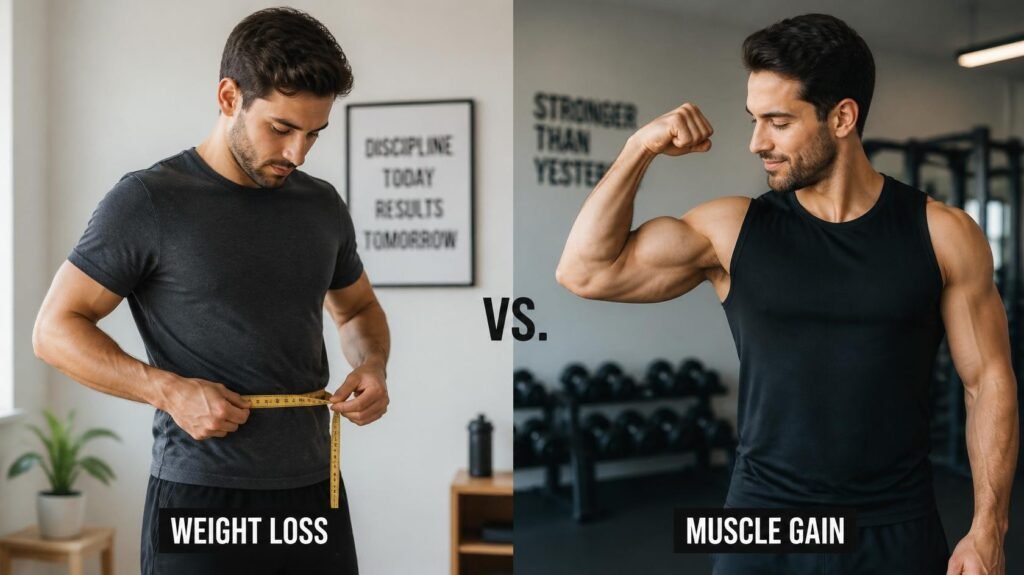
Understanding the Difference: Weight Loss vs Muscle Gain
What Weight Loss Actually Means
Weight loss — done properly — means reducing body fat while preserving as much muscle as possible. The common mistake is treating the number on the scale as the only measure of success. Scale weight includes muscle, water, bone density, and organ mass. What most people actually want is fat loss, not just a lower number — and those are not always the same thing.
To lose fat, your body needs to be in a calorie deficit: consistently consuming slightly fewer calories than it burns. When that gap is maintained over time, the body draws on stored fat for energy. The size of the deficit, combined with the right exercise and enough protein, determines how much of that loss comes from fat versus muscle.
What Muscle Gain Actually Means
Gaining muscle — also called hypertrophy — is the process of stimulating muscle fibres through resistance training and then giving them the nutrition and rest they need to rebuild bigger and stronger. It is a slower process than most people expect, and it requires a different nutritional approach to fat loss.
To build muscle effectively, your body generally needs a calorie surplus — slightly more calories than it burns — along with a high protein intake and progressive overload in training (gradually increasing the weight, reps, or difficulty of your sessions over time). Muscle does not appear from cardio alone. It requires direct, consistent resistance training.
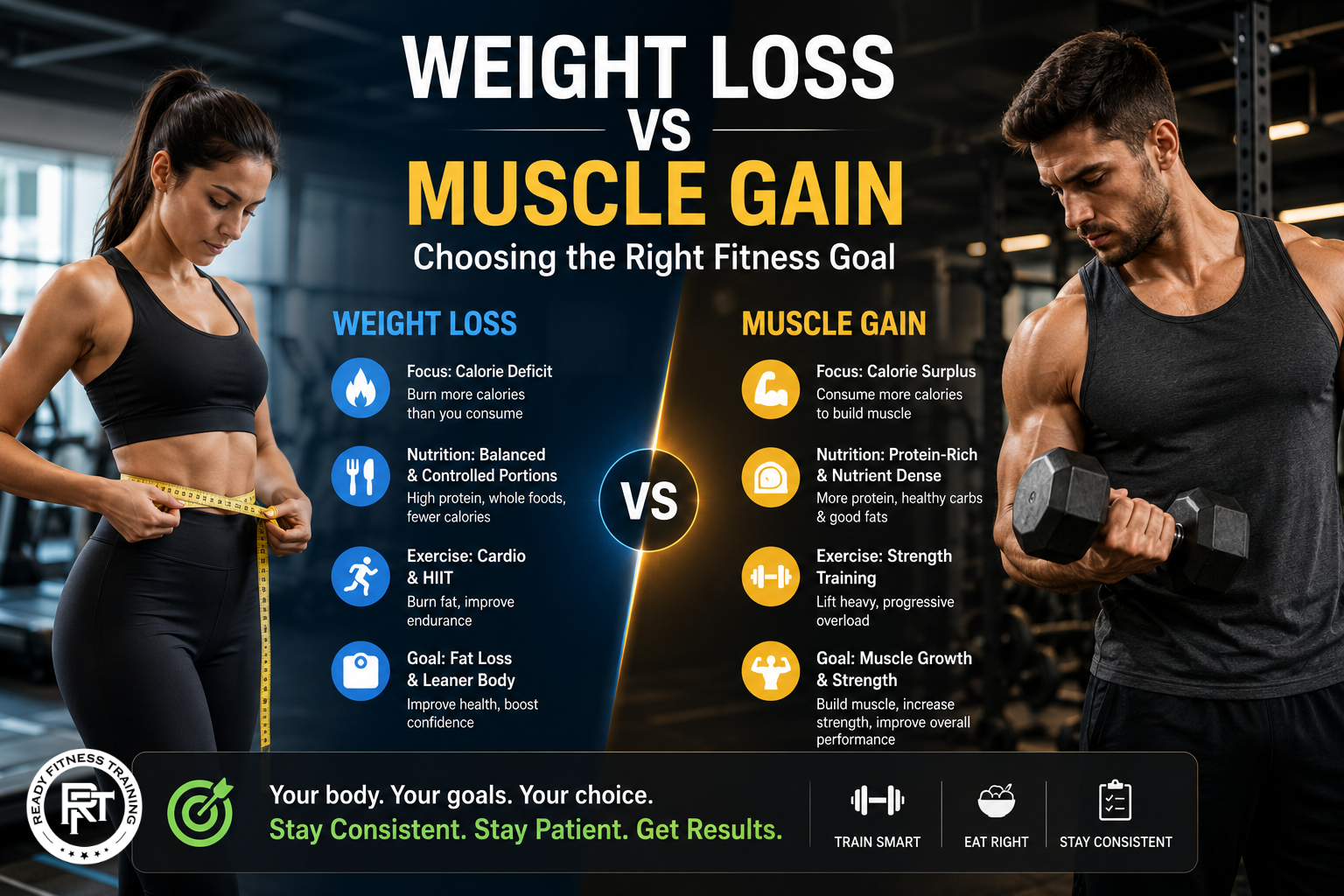
Weight Loss vs Muscle Gain: Side-by-Side
Before going deeper, here is a clear breakdown of how the two goals differ across the factors that actually shape your results:
| Factor | Weight Loss | Muscle Gain |
| Primary goal | Reduce body fat percentage | Increase lean muscle mass |
| Calorie approach | Calorie deficit (eat less than you burn) | Calorie surplus (eat slightly more) |
| Best training | Cardio + resistance training | Progressive resistance training |
| Protein needs | High — preserves muscle while losing fat | High — fuels muscle repair and growth |
| Timeline | Visible results in 4–8 weeks | Noticeable gains in 8–12 weeks |
| Scale focus | Weight goes down | Weight may go up (muscle is denser) |
| Cardio role | Central to calorie burn | Supportive — not the main focus |
| Best for | Improving health markers, fitting clothes better | Strength, posture, metabolic health |
Which Goal Should You Choose?
The honest answer is that the right goal depends on where you are starting from — not just what you want to look like. Here are the most common starting points and what tends to work best for each:
If You Have a Significant Amount of Fat to Lose
Start with fat loss. When body fat is high, the body is already in a position where building muscle is possible even in a moderate calorie deficit — a phenomenon called body recomposition, which we will cover shortly. Prioritising fat loss first also tends to improve energy levels, reduce strain on joints, and make resistance training more effective as you progress.
Most professionals recommend starting with a modest calorie deficit rather than an aggressive one. Losing 0.5 to 1 kilogram of body weight per week is a sustainable pace that gives you a reasonable chance of preserving muscle while the fat comes off.
If You Are Already Lean and Want to Look More Defined
Many people at a healthy weight want to look leaner without necessarily losing more weight — and the answer here is usually building muscle, not cutting calories further. When body fat is already relatively low, a modest muscle-building phase adds shape and definition that creates the ‘toned’ appearance most people are after. Dropping calories further at this stage often just results in losing muscle, which makes you feel smaller and weaker rather than defined.
If You Are a Complete Beginner
Beginners are in a genuinely unique position. Because the body responds so strongly to new training stimulus, many beginners can lose fat and gain muscle simultaneously — even without carefully calibrated nutrition. This window of opportunity (sometimes called ‘newbie gains’) does not last forever, but it does mean that beginners do not always need to choose one path immediately. Starting a solid training programme and eating enough protein is often the best first move.
Can You Lose Fat and Gain Muscle at the Same Time?
This is one of the most searched questions in fitness — and the answer is nuanced. Body recomposition (losing fat and gaining muscle simultaneously) is genuinely possible, but it tends to work best under specific conditions:
◆ You are new to training — beginners respond most strongly to recomposition because muscle-building is highly efficient when the body is new to the stimulus.
◆ You have a higher body fat percentage — people with more stored fat have more energy available to fuel muscle building even in a deficit.
◆ You are returning after a break — muscle memory is real. People returning to training after time off regain muscle faster than expected, even while losing fat.
◆ Your protein intake is high — consuming 1.6 to 2.2 grams of protein per kilogram of body weight per day is the range most commonly associated with successful recomposition.
For experienced, already-lean individuals, true simultaneous fat loss and muscle gain is very difficult to sustain. At that stage, most people benefit from cycling between a dedicated muscle-building phase and a fat-loss phase — rather than trying to chase both at once indefinitely.
How Training Differs for Each Goal
Training for Fat Loss
A combination of resistance training and cardiovascular exercise works best for fat loss. Resistance training preserves muscle while in a deficit — which is critical, because muscle is metabolically active and losing it slows your metabolism. Cardio increases calorie expenditure and supports cardiovascular health.
You do not need to spend hours on a treadmill. Three to four resistance training sessions per week, combined with two to three cardio sessions (or simply increasing daily movement through walking), is enough to create meaningful fat loss results without burning out.
Training for Muscle Gain
Progressive resistance training is the foundation of muscle building. The principle is straightforward: consistently challenge the muscles with increasing resistance over time, and they will adapt by growing stronger and larger. Compound movements — squats, deadlifts, bench press, overhead press, rows — recruit the most muscle fibres and deliver the strongest training stimulus.
Cardio during a muscle-building phase is fine and has health benefits, but too much can interfere with recovery and slow muscle growth if it significantly eats into your calorie surplus. Keeping it moderate — two to three sessions per week of low to moderate intensity — tends to give the best of both worlds.
Nutrition: The Piece That Makes or Breaks Your Goal
Eating for Fat Loss
A calorie deficit is non-negotiable for fat loss, but the quality of that deficit matters. Crash diets and extremely low-calorie approaches tend to result in muscle loss, fatigue, and rebound weight gain. A moderate deficit — around 300 to 500 calories below your maintenance level — allows steady fat loss without destroying energy or muscle.
Protein is the most important dietary variable for fat loss. Keeping protein high (1.6g per kg of body weight or more) while in a deficit helps preserve muscle, keeps you feeling fuller for longer, and has a higher thermic effect than fat or carbohydrates (meaning your body burns more calories digesting it).
Eating for Muscle Gain
Building muscle requires adequate fuel. Most people do this with a modest calorie surplus — roughly 200 to 400 calories above maintenance — which provides the energy needed for training and recovery without piling on excess fat. Larger surpluses do not build muscle faster; they just add more body fat alongside any muscle gains.
Protein targets for muscle gain are similar to fat loss — 1.6 to 2.2 grams per kilogram of body weight per day. Carbohydrates play a significant role too, providing the glycogen that fuels intense training sessions and supports recovery.
| The Rule That Applies to Both Goals: Consistency over months matters far more than perfection over days. The best training programme is the one you actually do. The best diet is the one you can genuinely sustain. If your plan is so rigid that one bad week derails everything, it is not the right plan. |
Common Mistakes That Slow Down Both Goals
◆ Not eating enough protein — whether you are losing fat or building muscle, protein is the single most important dietary lever. Most people undereat it significantly.
◆ Skipping resistance training during fat loss — cardio-only approaches to weight loss reliably result in muscle loss alongside fat loss, leaving you softer and weaker than expected.
◆ Eating too large a surplus for muscle gain — excess calories above what the body can use for muscle building just become fat. A modest surplus is smarter than an aggressive one.
◆ Changing the plan too often — results in both goals take weeks and months to show. Switching approaches every two to three weeks because progress feels slow is one of the most common reasons people stay stuck.
◆ Measuring only with the scale — during muscle building, the scale may go up even as you look and feel significantly better. Body measurements, progress photos, and strength gains are more useful indicators.
Frequently Asked Questions
Should I lose weight before building muscle?
If you have a significant amount of fat to lose, starting with fat loss is generally the better approach. It improves your starting point for muscle building, reduces health risks, and gives you a cleaner base to build from. Once you reach a body fat level you are comfortable with, shifting to a muscle-building phase tends to produce better aesthetic results than trying to do both simultaneously.
Why am I not losing weight even though I am exercising?
The most common reason is that calorie intake is higher than it appears. Exercise alone rarely creates a large enough calorie deficit to cause significant weight loss — especially if appetite increases in response to training. Tracking food intake, even roughly, tends to reveal gaps that explain the plateau. Other factors include underestimating portion sizes, eating back exercise calories, or not accounting for liquid calories.
How long does it take to see results from muscle building?
Most people begin to notice strength improvements within two to four weeks — even if the physical change is not yet visible. Visible muscle gains typically become noticeable after eight to twelve weeks of consistent, progressive training with adequate nutrition. Significant body composition changes usually take three to six months of sustained effort.
Is it possible to do weight loss and muscle gain at the same time?
Yes, under the right conditions — particularly for beginners, people returning to training after a break, and those with higher body fat. For experienced, already-lean individuals, simultaneous fat loss and muscle gain is very difficult and slow. Most people at that stage get better results by alternating between dedicated fat-loss and muscle-building phases.
How much protein do I need for fat loss or muscle gain?
Both goals benefit from a similar protein target: approximately 1.6 to 2.2 grams per kilogram of body weight per day. This range supports muscle preservation during fat loss and muscle repair and growth during a building phase. Spreading protein intake across three to four meals throughout the day tends to maximise its effectiveness.
The Bottom Line
Weight loss and muscle gain are not opposing forces — they are different tools for different situations. Understanding which one your body needs right now, and building a plan that actually serves that goal, is what separates people who see consistent progress from people who stay frustrated despite working hard.
If you have a meaningful amount of fat to lose, start there. If you are already at a healthy weight but want more shape and strength, build muscle. If you are brand new to training, start moving and eating well — the results will come naturally before you even need to make that choice.
The goal is not to pick the harder path or the more impressive-sounding one. It is to pick the one that moves you forward from exactly where you are standing right now.
This article is for informational and educational purposes only and does not constitute personalised fitness or medical advice. Results vary depending on individual health status, consistency, and lifestyle factors. Consult a qualified fitness professional or healthcare provider before making significant changes to your diet or exercise routine.