
Medical Weight Loss in St. Louis, MO
What You Need to Know Before You Start
Updated 2025 | A Practical Guide for St. Louis Residents Considering Medically Supervised Weight Management
Reviewed for clinical accuracy by a licensed medical weight loss practitioner | For informational purposes only — not a substitute for a personalised medical consultation
Most people in St. Louis who struggle with their weight have already tried the conventional approaches. The diets. The calorie counting. The gym memberships that lasted through February. The commercial programmes with weekly weigh-ins. Sometimes these work. More often, they work for a while and then stop working — or never produce the results that the effort should reasonably have produced — because weight is not simply a matter of effort and willpower. It is a biological problem with biological dimensions that most commercial programmes are not equipped to address.
Medical weight loss gym in St. Louis is different. It is the management of weight as a medical condition, supervised by licensed clinicians who can assess what is actually driving weight difficulty in your specific body — hormonal imbalances, insulin resistance, medication side effects, thyroid dysfunction, genetic factors — and prescribe evidence-based interventions that commercial programmes cannot offer, including the GLP-1 receptor agonist medications that have transformed the landscape of obesity medicine over the last several years.
The direct answer on what medical weight loss in St. Louis involves: a clinical assessment of your metabolic and hormonal health, a personalised plan that may include prescription medications, nutritional support, behavioural coaching, and ongoing medical monitoring. It is not a quick fix. It is a structured, evidence-based approach to a condition that, for many people, cannot be resolved through diet and exercise alone.

Why Medical Weight Loss Exists — and Who It’s For
Obesity is classified as a chronic disease by the American Medical Association, the World Health Organization, and the CDC. It is not a character failure or a motivation problem. The body has complex feedback systems — leptin, ghrelin, insulin, cortisol, thyroid hormones — that regulate hunger, satiety, energy storage, and metabolic rate. These systems can become dysregulated in ways that make weight loss genuinely harder than it should be, independent of how carefully someone follows a diet.
For people who have this kind of biological resistance to weight loss — and research suggests this is the majority of people with significant excess weight — the conventional advice to ‘eat less and move more’ is both true and insufficient. It addresses the energy balance equation without addressing the hormonal and metabolic environment that determines how much you need to eat to feel full, how efficiently your body stores or burns fat, and whether the weight you lose stays off.
Medical weight loss is for St. Louis residents who:
-> Have tried commercial weight loss programmes without achieving lasting results
-> Have a BMI of 27 or above — particularly with weight-related health conditions (type 2 diabetes, hypertension, sleep apnea, joint pain)
-> Suspect an underlying hormonal or metabolic condition is affecting their weight
-> Want access to evidence-based prescription tools (GLP-1 medications) that require a prescriber
-> Need structured medical monitoring because of health conditions that make unsupervised weight loss approaches risky
-> Have significant weight to lose and want the most effective evidence-based approach available
Medical Weight Loss Options Available in St. Louis
A comprehensive medical weight loss programme in the St. Louis area may include any combination of the following:
| Treatment Option | What It Involves |
| GLP-1 receptor agonists (semaglutide / tirzepatide) | Prescription injection or oral medication that reduces appetite and slows gastric emptying; evidence-based with significant clinical trial data; weekly injections |
| Prescription appetite suppressants | Older medications (phentermine, topiramate, bupropion/naltrexone) with established track records; used when GLP-1s are not appropriate or affordable |
| Medically supervised VLCD | Very low calorie diet (typically 800 kcal/day or less) using meal replacement products, with medical monitoring; effective for rapid initial weight loss |
| Metabolic and hormonal assessment | Thyroid function, insulin resistance, cortisol, and hormonal panels that identify underlying causes of weight difficulty — not weight loss itself, but essential context |
| Behavioural and lifestyle coaching | Structured support for eating behaviour, physical activity, sleep, and stress — the habits that determine whether any other intervention produces durable results |
| Weight loss surgery referral | For appropriate candidates (BMI 40+, or 35+ with comorbidities) — medical weight loss programme can assess eligibility and provide pre- and post-surgical support |
The approach that is right for any individual depends on their starting weight, their health history, the underlying factors contributing to their weight, and their goals. A medical weight loss programme in St. Louis begins with a clinical assessment that maps these factors before recommending a specific combination. Any programme that recommends a treatment plan before completing that assessment is not doing it correctly.
GLP-1 Medications in St. Louis — What They Are and What They Do
The GLP-1 receptor agonist medications — semaglutide (sold as Ozempic for diabetes and Wegovy for weight loss) and tirzepatide (sold as Mounjaro for diabetes and Zepbound for weight loss) — have become the most significant development in obesity medicine in decades. Their clinical trial results are genuinely remarkable: in the STEP trials, semaglutide produced average weight loss of 15 percent of body weight over 68 weeks. Tirzepatide produced up to 22 percent weight loss in the SURMOUNT-1 trial.
These are not appetite suppressants in the traditional sense. GLP-1 agonists mimic a gut hormone that is naturally released after eating. They slow gastric emptying (food stays in the stomach longer, producing fullness for longer), reduce appetite signals in the brain, and improve the way the body handles glucose. For many people, they fundamentally change the experience of hunger — the relentless, intrusive hunger that has undermined every previous diet attempt simply becomes quieter.
In St. Louis, GLP-1 medications are available through medical weight loss clinics, obesity medicine specialists, some internal medicine and primary care practices, and telehealth platforms. They require a prescription and a clinical assessment. The prescribing provider should review your health history, current medications, and any contraindications (they are not appropriate for people with a personal or family history of medullary thyroid carcinoma or MEN2 syndrome, among other contraindications).
The most important honest point about GLP-1 medications: they work while you take them. Weight regain when medications are stopped is well-documented. This is not a failure of the patient — it reflects the chronic nature of obesity. Medical weight loss programmes that include GLP-1 medications should also include a plan for long-term management, whether that is continued medication, a strong lifestyle foundation, or both.
Medical Weight Loss vs Commercial Programs — How They Compare
St. Louis has no shortage of weight loss options — from national commercial programs to local gyms and nutrition coaches. Here is an honest comparison of what medical and commercial approaches offer:
| Factor | Medical Weight Loss | Commercial Program |
| Approach | Evidence-based; clinician-led; uses prescription tools | Commercial plan; coach or group-based; no prescribing |
| Assessment | Blood work, medical history, metabolic panel | Typically questionnaire-based; no clinical evaluation |
| Medications | Can prescribe GLP-1s, appetite suppressants, thyroid Rx | Cannot prescribe; supplements only |
| Health monitoring | Regular check-ins; labs; weight, BP, glucose tracking | Weight tracking; no clinical monitoring |
| Underlying causes | Can identify and treat hormonal or metabolic barriers | Assumes standard diet/lifestyle approach works for all |
| Cost | Higher — $150–$500+/month; insurance may cover some | Lower — $30–$100/month; insurance rarely applicable |
| Best for | People with significant weight, health conditions, or those who have not responded to commercial approaches | People with 10–20 lbs to lose, no significant health conditions |
The comparison is not intended to dismiss commercial weight loss programmes — for people who are relatively healthy, have modest weight loss goals, and have not tried structured lifestyle programmes before, commercial approaches are a reasonable starting point. Medical weight loss is most clearly the better choice when previous commercial attempts have failed, when weight-related health conditions are present, or when the magnitude of weight loss needed makes a medical framework appropriate.
What to Expect at a Medical Weight Loss Clinic in St. Louis
Understanding what a good medical weight loss consultation and programme looks like helps you evaluate what you find. Here is what the process should include:
-> A comprehensive initial assessment — medical history, current medications, weight history, previous weight loss attempts, diet and exercise patterns, sleep quality, stress levels, and a physical examination. Blood work to assess thyroid function, insulin resistance, fasting glucose, lipid panel, and other relevant markers.
-> A discussion of what is actually driving your weight difficulty — not a generic plan, but a conversation about which factors in your specific situation are most relevant. Are there hormonal barriers? Is insulin resistance a significant factor? Has previous rapid weight loss affected your metabolic rate?
-> A personalised plan — combining whatever intervention or interventions are most appropriate for your situation. This might be GLP-1 medication, a structured VLCD, nutrition coaching, exercise prescription, or some combination. The plan should be explained clearly, with realistic expectations.
-> Ongoing monitoring — regular follow-up appointments, periodic blood work, weight and metabolic tracking, and adjustment of the plan as you progress. Good medical weight loss is not a one-time consultation — it is an ongoing clinical relationship.
-> Realistic expectations — a good provider will tell you honestly what is achievable, on what timeline, and what the plan is for maintaining results. If a consultation promises rapid specific results without acknowledging the variable nature of weight loss, that is a flag.
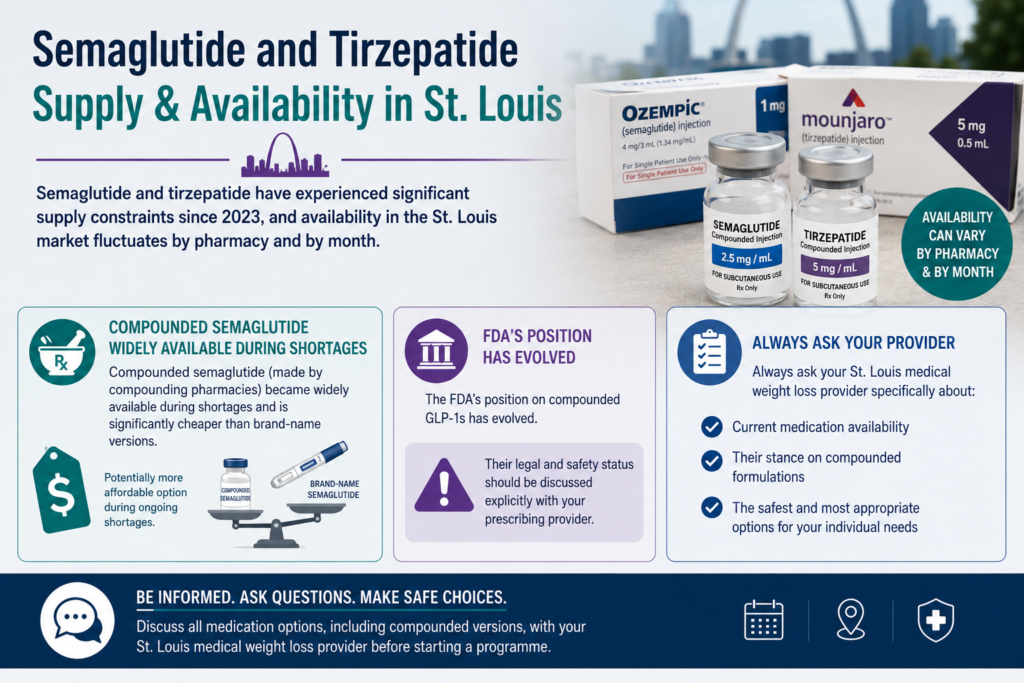
| The GLP-1 Medication Supply Situation in St. Louis — What to Know: Semaglutide and tirzepatide have experienced significant supply constraints since 2023, and availability in the St. Louis market fluctuates by pharmacy and by month. Compounded semaglutide (made by compounding pharmacies) became widely available during shortages and is significantly cheaper than brand-name versions — but the FDA’s position on compounded GLP-1s has evolved, and its legal and safety status should be discussed explicitly with your prescribing provider. Always ask your St. Louis medical weight loss provider specifically about current medication availability and their stance on compounded formulations before starting a programme. |
Frequently Asked Questions — Medical Weight Loss in St. Louis, MO
What is medical weight loss?
Medical weight loss is the supervised management of overweight and obesity by licensed clinicians, treating excess weight as a medical condition rather than a lifestyle choice. In St. Louis, this typically involves an initial clinical assessment (blood work, medical history, metabolic evaluation), a personalised treatment plan that may include prescription medications (including GLP-1 receptor agonists like semaglutide or tirzepatide), nutritional and behavioural support, and ongoing medical monitoring. It differs from commercial weight loss programmes by involving prescribers who can order lab work, diagnose underlying conditions, and prescribe evidence-based medications.
How much does medical weight loss cost in St. Louis?
Medical weight loss costs in St. Louis vary by provider and programme structure. Initial consultations typically run $150 to $350. Monthly programme fees (including follow-up visits and monitoring) range from $150 to $500 or more depending on the level of support included. GLP-1 medications add significant cost: brand-name semaglutide (Wegovy) lists at approximately $1,300 per month, though manufacturer savings cards and patient assistance programmes may reduce this substantially. Compounded semaglutide is available at lower cost through some St. Louis clinics. Many commercial insurance plans now cover GLP-1 medications for obesity; Medicare and Medicaid coverage varies by plan and indication.
Are GLP-1 medications like semaglutide available in St. Louis?
Yes — semaglutide (Ozempic, Wegovy) and tirzepatide (Mounjaro, Zepbound) are available through medical weight loss clinics, obesity medicine specialists, and some primary care practices in the St. Louis area. Telehealth platforms also prescribe these medications to Missouri residents. Supply availability has fluctuated since 2023; discuss current availability with your provider. Compounded semaglutide is available through some St. Louis clinics and has been significantly cheaper, but FDA guidance on compounded GLP-1 medications has evolved and should be discussed explicitly with your prescriber.
Does health insurance cover medical weight loss in St. Louis?
Coverage varies significantly by insurance plan. GLP-1 medications for obesity (Wegovy, Zepbound) are covered by an increasing number of commercial insurance plans, though prior authorisation is usually required and BMI and comorbidity criteria apply. Medicare currently covers GLP-1 medications for cardiovascular risk reduction but has limited obesity-specific coverage, though this is evolving. The clinical consultation and monitoring components of medical weight loss programmes may be covered as preventive care or chronic disease management visits. Always verify your specific coverage directly with your insurer and confirm the billing codes your St. Louis provider uses.
What should I look for in a medical weight loss provider in St. Louis?
Look for a provider who completes a comprehensive initial assessment including blood work — not just a consultation where medications are prescribed on the same day as the first visit without clinical evaluation. Credentials matter: board certification in obesity medicine (ABOM), internal medicine, endocrinology, or family medicine with specific obesity medicine training indicate relevant expertise. Transparency about medication costs, compounded formulations, and programme fees is a positive sign. Ask specifically whether ongoing monitoring is included, how frequently you will be seen, and what the plan is for maintaining results long-term. A provider who rushes through the first appointment or makes weight loss sound simpler than it is may not be offering the level of care that produces durable outcomes.
How much weight can I expect to lose with a medical weight loss programme in St. Louis?
Expected weight loss varies by programme and individual. Lifestyle-based medical weight loss (without medications) typically produces 5 to 10 percent loss of starting weight over six to twelve months. With GLP-1 medications like semaglutide, clinical trials show average losses of 12 to 15 percent of body weight over 68 weeks; tirzepatide shows up to 20 to 22 percent. These are averages — individual responses vary. The timeline for seeing meaningful results is typically three to six months. Providers who promise specific results or rapid dramatic losses without acknowledging individual variability are not giving you an honest picture.
Finding the Right Medical Weight Loss Support in St. Louis
The St. Louis area has a growing number of medical weight loss options — from hospital-affiliated bariatric programmes and obesity medicine specialists to primary care practices that have added weight management services and dedicated medical weight loss clinics. The quality and comprehensiveness of what is offered varies significantly, and the GLP-1 medication boom has also attracted providers whose programmes are thin on clinical depth and heavy on medication sales.
The questions worth asking before committing to any St. Louis medical weight loss programme: Does the first appointment include lab work or a comprehensive clinical evaluation? What happens if the medication is unavailable? What is the plan if you do not respond to the first approach? What support is available for the behavioural side of weight management — not just the prescription side?
The right programme in St. Louis is one that treats your weight as what it is — a medical condition with specific causes in your specific body — and applies evidence-based tools to address those causes with your long-term health as the goal. That is a different kind of help than a commercial programme can provide. For many St. Louis residents, it is also the help that finally works.
This article is for informational and educational purposes only. It does not constitute medical advice or a recommendation for any specific clinic or treatment. Medical weight loss approaches, medication availability, and insurance coverage change frequently. Always consult a licensed healthcare professional for a personalised assessment before starting any weight management programme.
Keywords: medical weight loss St. Louis MO · medical weight loss St. Louis · weight loss clinic St. Louis MO · GLP-1 St. Louis · semaglutide St. Louis MO · supervised weight loss program St. Louis · weight loss doctor St. Louis · Ozempic St. Louis · Wegovy Missouri