How Physical Therapy Helps You Return to Sports Safely
What the Process Actually Looks Like — and Why It Cannot Be Rushed
Updated 2025 | A Practical Guide for Athletes, Coaches, and Anyone Recovering from a Sports Injury
Reviewed for clinical accuracy by a licensed sports physical therapist | For informational purposes only — not a substitute for individual assessment and treatment
Every athlete who gets injured eventually asks the same question: when can I play again? The answer is almost always more complicated than the injury itself suggests, and the temptation to rush back is one of the most reliable predictors of reinjury.
Physical therapy exists precisely in this gap — between the moment an injury stops being acute and the moment a person is genuinely ready to compete again. It is not just about managing pain or getting range of motion back. It is about rebuilding the strength, stability, neuromuscular control, and sport-specific movement patterns that allow the body to handle the real demands of sport without breaking down again.
The honest truth: returning to sport too early is the single biggest modifiable risk factor for reinjury. Physical therapy, done properly and followed through completely, reduces that risk by ensuring the body is actually ready — not just no longer in pain. Pain resolution is not the same as readiness. A good physical therapist will not clear you for sport until both are true.
This guide explains what sports physical therapy actually does, how a structured return-to-sport programme works, and what the most common sports injuries look like in rehabilitation.
Why Physical Therapy — Not Just Rest — Is the Right Answer
Rest is the beginning of recovery. It is not the end of it. This is a distinction that most athletes understand intellectually but struggle with in practice, particularly when pain subsides and things feel normal again.
The problem is that tissue heals faster than strength returns, and strength returns faster than neuromuscular control. You can have no pain, regain full range of motion, and still have significant deficits in the muscle activation patterns that actually protect a joint under load. This is why athletes who return based on pain levels alone reinjure at dramatically higher rates than those who complete a structured rehabilitation programme.
Physical therapy addresses all three layers of recovery — tissue healing, strength, and neural control — through a progressive loading programme that is calibrated to where the body actually is at each stage, not where the athlete wants to be.
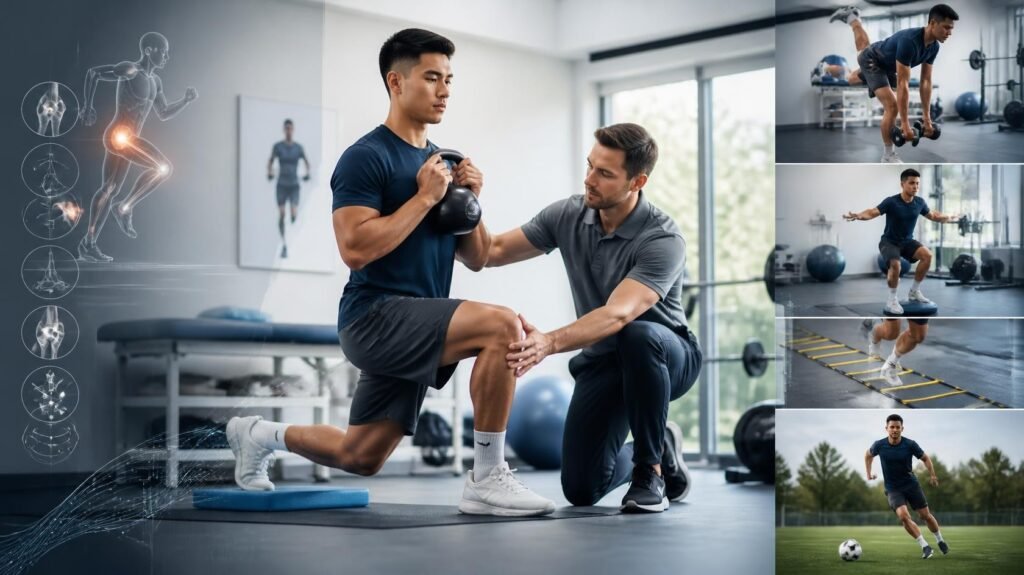
Beyond the biomechanical case, there is a psychological one. Athletes who have been through a significant injury — particularly ACL tears, labral injuries, and fractures — frequently struggle with confidence and fear of reinjury when they return. A skilled sports physical therapist addresses this as part of the process, using graduated exposure to higher-intensity movements to rebuild both physical capacity and psychological readiness at the same time.
The Return-to-Sport Phases — What a Structured Programme Looks Like
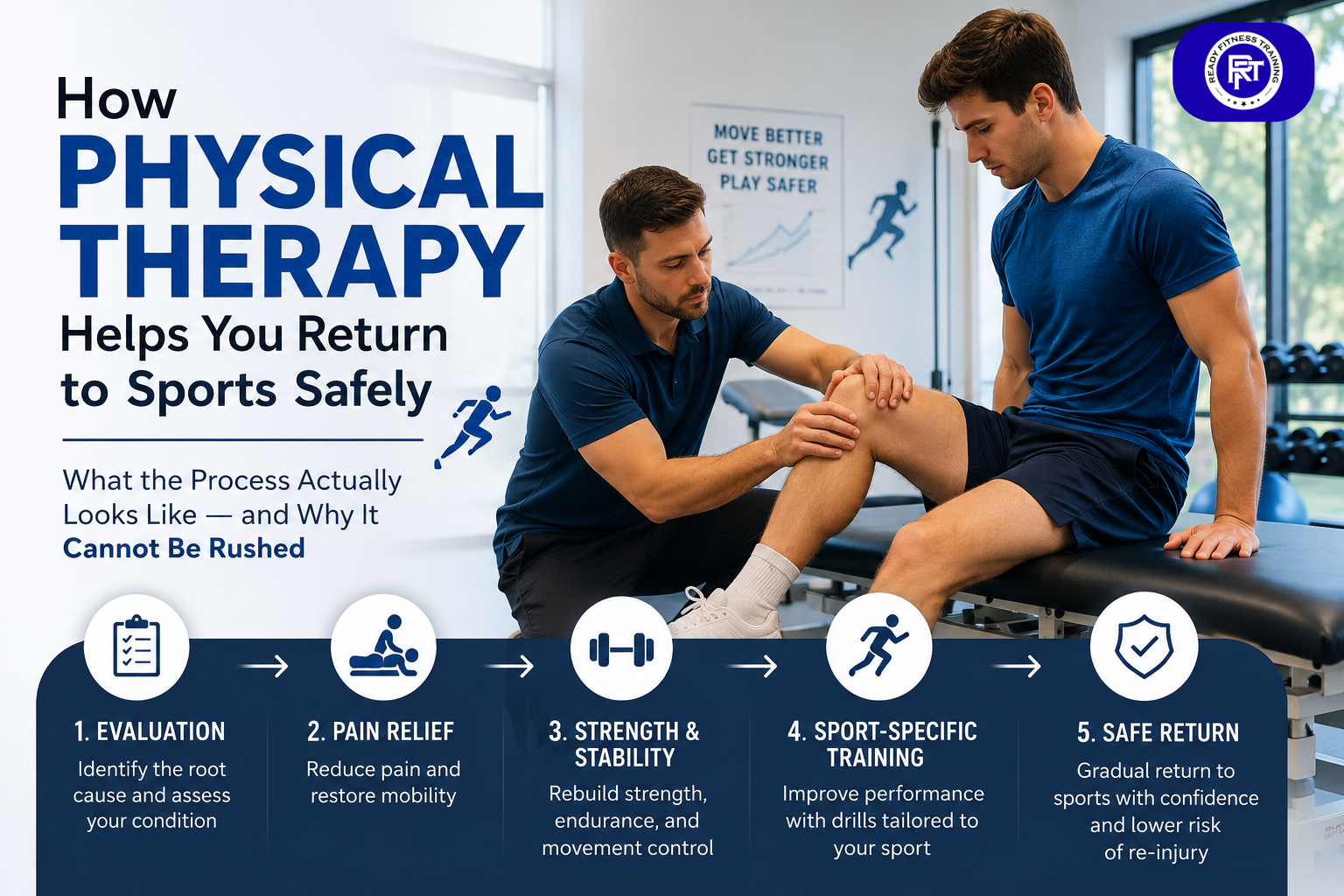
Structured return-to-sport programmes vary by injury and sport, but they follow a common framework with six progressive phases. Movement through each phase is gated by objective criteria — strength tests, movement assessments, functional benchmarks — rather than time alone.
| Phase | What Happens and Why It Matters |
| Phase 1 — Protection & Rest | Manage pain and swelling; protect the injured area; light pain-free movement begins |
| Phase 2 — Restore Movement | Regain full or near-full range of motion; break down scar tissue; begin gentle loading |
| Phase 3 — Rebuild Strength | Progressive resistance training targeting injured and surrounding muscles; address asymmetries |
| Phase 4 — Neuromuscular Control | Balance, proprioception, and coordination training; retrain the nervous system |
| Phase 5 — Sport-Specific Prep | Movements that replicate the demands of your sport: cutting, jumping, sprinting, throwing |
| Phase 6 — Full Return to Sport | Graded reintegration — practice before games, games before competition, monitored throughout |
The critical principle across all phases is progressive overload with adequate recovery. Each session is slightly more demanding than the last, but the demand never jumps beyond what the healing tissue and nervous system can handle. Regression is normal and expected — if a phase pushes too hard, the programme steps back. This is not failure; it is appropriate management.
What Physical Therapy Actually Does — The Specific Interventions
Manual Therapy and Soft Tissue Work
Hands-on techniques — joint mobilisation, soft tissue massage, myofascial release, and dry needling in some cases — address restrictions in movement that exercise alone cannot resolve. A stiff ankle after a sprain, for example, loses dorsiflexion (the ability to bring the foot upward) in ways that directly affect running, squatting, and landing mechanics. Restoring this mechanically, before loading the joint, prevents the compensatory movement patterns that often cause secondary injuries elsewhere.
Progressive Strength Training
This is the core of sports rehabilitation. Strength deficits in the injured area — and in the surrounding structures that load-share with it — are one of the primary risk factors for reinjury. Hamstring weakness after an ACL tear, for example, contributes to knee instability that persists long after the ligament has healed. Progressive resistance training, starting at loads the tissue can handle and advancing systematically, addresses these deficits in a controlled way.
The type of loading matters as much as the volume. Eccentric loading — where a muscle is strengthening while lengthening — is particularly important for tendon injuries and hamstring strains because it most closely replicates the load demands of sprinting, deceleration, and change of direction.
Neuromuscular and Proprioception Training
Proprioception is the body’s ability to sense where a joint is in space and respond to sudden forces automatically. It lives in the mechanoreceptors in ligaments, tendons, and joint capsules — and it is significantly disrupted by injury. After an ankle sprain, for example, the ligament damage reduces proprioceptive input from that ankle, making it slower to respond to uneven surfaces. This is why athletes who skip rehabilitation have a dramatically higher rate of repeat ankle sprains — the injury healed, but the protective reflex did not fully recover.
Balance boards, perturbation training, single-leg exercises, and reactive drills all target this system. None of them look particularly impressive in a rehabilitation gym, but they are addressing one of the most important deficits that creates reinjury risk.
Sport-Specific Retraining
The final stages of a sports rehabilitation programme should look increasingly like the sport itself. A rugby player needs to work through contact scenarios. A tennis player needs to rehearse overhead serving mechanics. A distance runner needs to complete structured run-walk progressions that mirror their training load. Generic exercise is not enough at this stage — the body needs to be prepared for the specific movements, speeds, and forces it will encounter in competition.
This is where working with a physical therapist who understands your sport is genuinely valuable. The exercises in this phase are not improvised — they are based on the biomechanical demands of the specific sport and position, and they are progressed in a way that matches the return-to-training timeline.

Common Sports Injuries — What PT Focuses On and Typical Timelines
Every injury is different, and these timelines are general guides — individual recovery depends on severity, age, fitness level, and how consistently the programme is followed. That said, here is what physical therapy typically addresses for the most common sports injuries:
| Injury | Typical Timeline | What PT Focuses On |
| ACL tear | 3–9 months | Quad/hamstring rebuilding, knee stability, neuromuscular retraining, sport-specific drills |
| Ankle sprain | 2–8 weeks | Range of motion restoration, proprioception training, strength work, balance drills |
| Rotator cuff injury | 4–12 weeks | Shoulder mechanics, scapular stability, rotator cuff strengthening, sport-specific throwing progression |
| Hamstring strain | 2–8 weeks | Eccentric loading protocols (Nordic curls), sprint mechanics, running reintroduction |
| Stress fracture | 6–12 weeks | Offloading, bone loading progression, biomechanical correction of contributing factors |
| Shin splints (MTSS) | 2–6 weeks | Load management, calf and tibial muscle strengthening, running form assessment |
| Tennis/golfer’s elbow | 4–12 weeks | Eccentric wrist and forearm exercises, grip loading, technique correction |
| Concussion | Days–weeks | Vestibular rehab, exertion testing, graduated return to play protocol (mandatory) |
Two important notes about these timelines: first, they represent the time to return to sport — not the time to feel normal. Many athletes feel substantially better weeks before they are actually ready to compete safely. Second, the ‘return to sport’ endpoint means full unrestricted sport, not just light training. Getting from light training to full competition is a stage many athletes rush through, and it is where a significant proportion of reinjuries occur.
| Signs You Are Not Yet Ready to Return — Red Flags to Know Pain during sport-specific movements. Strength deficit greater than 10–15% compared to the uninjured side. Avoiding or compensating during a movement that should be symmetrical. Significant anxiety about reinjury that is affecting how you move. Inability to perform sport-specific tasks at full speed without hesitation. Any of these is a signal to slow down — not an indication that something has gone wrong, but that the programme has more work to do. |
What Good Sports Physical Therapy Actually Looks Like
Not all rehabilitation is the same quality. The difference between a structured sports rehabilitation programme and generic physiotherapy often determines whether an athlete returns successfully or reinjures within months.
-> Objective testing at each phase — a good PT uses strength measurements, hop tests, balance assessments, and movement screens to make return decisions based on data, not just how you feel.
-> Sport-specific understanding — your therapist should understand the specific demands of your sport and position. The rehabilitation for a goalkeeper is different from that for a winger, even with the same injury.
-> Clear criteria for progression — you should know at each stage what you need to achieve before moving forward. Arbitrary timelines without functional benchmarks are a warning sign.
-> Communication with your coach or team medical staff — if you play in an organised sport, your PT should be aligned with your coach or team doctor on the return timeline and any restrictions during the transition back.
-> Attention to psychological readiness — fear of reinjury is a legitimate barrier to full performance. A good PT addresses this directly, using graduated exposure and confidence-building exercises, not just telling you that you are medically cleared.
Frequently Asked Questions — Physical Therapy and Return to Sport
How does physical therapy help return to sport?
Physical therapy supports return to sport through a structured, progressive programme that addresses every layer of recovery: tissue healing, strength rebuilding, neuromuscular retraining, and sport-specific movement preparation. It ensures that when an athlete returns to competition, the body is physically capable of handling the demands of sport — not just pain-free. The process also builds psychological confidence through graduated exposure to higher-intensity movements.
How long does physical therapy for a sports injury take?
This varies significantly by injury type and severity. Minor sprains and strains may require two to six weeks of rehabilitation. Moderate injuries like partial ligament tears or muscle strains typically take six to twelve weeks. Major injuries like ACL tears or complex fractures often require four to nine months before full return to sport. The timelines in this article are general guides — individual recovery depends on age, fitness level, injury severity, and how consistently the rehabilitation programme is followed.
When is it safe to return to sport after an injury?
Return to sport is safe when several criteria are met: pain is absent or below a functional threshold during sport-specific movements, strength in the injured limb is within 10 to 15 percent of the uninjured side, neuromuscular control and balance have been restored, and sport-specific tasks can be performed at full speed without compensatory movement patterns. Pain resolution alone is not sufficient — tissue can heal before the supporting strength and neural systems have fully recovered.
What is a return-to-sport protocol?
A return-to-sport protocol is a structured, staged framework that guides an athlete from post-injury rest through to full competition. It typically includes six phases: protecting the injury and reducing inflammation, restoring range of motion, rebuilding strength, retraining neuromuscular control, completing sport-specific drills, and graded reintegration into training and competition. Movement through each phase is controlled by functional criteria — objective tests of strength, balance, and movement quality — rather than time alone.
Can physical therapy prevent sports injuries?
Yes — preventive physical therapy is an established and evidence-based approach, particularly for athletes with a history of injury or known risk factors. Injury prevention programmes like the FIFA 11+ (for soccer), neuromuscular training programmes for ACL prevention, and load management strategies have all demonstrated reductions in injury rates in controlled studies. A sports physical therapist can also identify movement asymmetries and weakness patterns before they cause injury and address them proactively.
What is the biggest risk factor for reinjury in sports?
Returning to sport too early — before strength, neuromuscular control, and sport-specific function have been adequately restored — is the single biggest modifiable risk factor for reinjury. Strength deficits greater than 10 to 15 percent compared to the uninjured side, incomplete proprioceptive recovery, and inadequate sport-specific preparation are the specific deficits most commonly associated with reinjury after return. A structured physical therapy programme addresses all of these systematically before clearing an athlete for competition.
The Bottom Line
Physical therapy is not a box to tick on the way back to sport. It is the process that determines whether the return is successful — and whether it sticks. The athletes who reinjure within months of returning almost always have one thing in common: they came back before they were actually ready, because feeling better felt like being ready.
A good sports physical therapist will not let you make that mistake. They will measure what they cannot see from the outside — the strength deficits, the proprioceptive gaps, the movement compensations — and address each one before sending you back to training. That process takes the time it takes. Pushing through it faster does not make the body heal faster. It just shifts the reinjury from a possibility to a probability.
Get the right rehabilitation. Follow it through completely. The sport will still be there when you are genuinely ready for it.
This article is for informational and educational purposes only. It does not constitute medical advice or a treatment recommendation. Sports injuries and rehabilitation timelines vary significantly between individuals. Always consult a licensed physical therapist or sports medicine physician for a personalised assessment and treatment plan.
Keywords: physical therapy return to sport · return to sport after injury · sports injury rehabilitation · physical therapy for athletes · ACL recovery physical therapy · return-to-play protocol · neuromuscular training · sports physical therapy