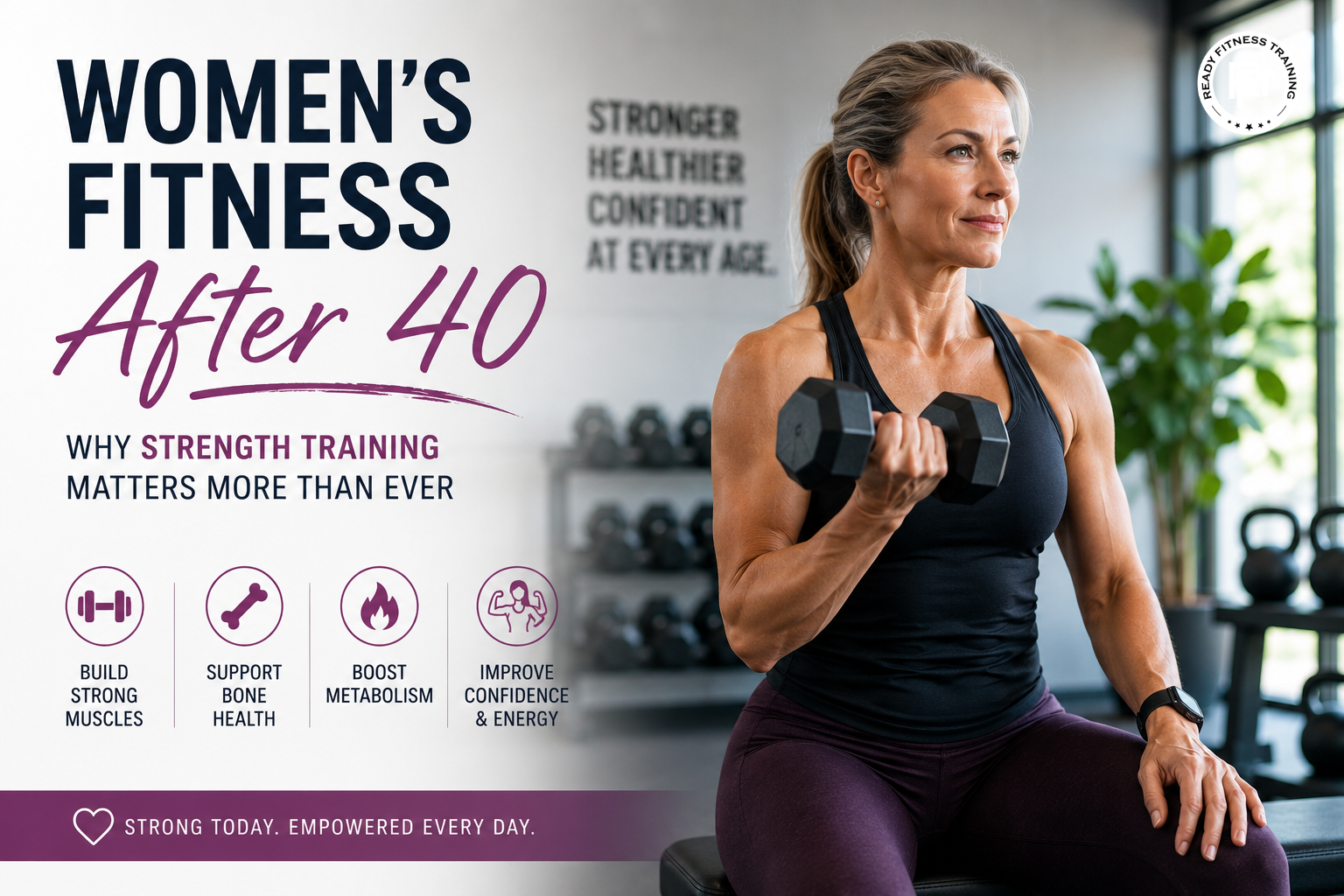
Women’s Fitness After 40
Why Strength Training Matters More Than Ever
Updated 2025 | The Evidence-Based Case for Picking Up Weights in Your 40s, 50s, and Beyond
Written by certified fitness practitioners with expertise in women’s health and strength training | For women in their 40s, 50s, and beyond who want evidence-based guidance on exercise
For most of her life, a woman might have associated fitness with cardio. Walking, running, cycling, aerobics classes — the kinds of exercise that feel appropriately effortful and leave you breathless. These are genuinely good for you. But after forty, something changes in the body’s priorities, and the exercise that has the most impact on long-term health, independence, and how you feel day to day is not the treadmill. It is the weight room.
This is not about aesthetics or weight loss — though strength training supports both. It is about the specific biological changes that begin in a woman’s forties that cardio alone cannot counteract. Bone density loss. Muscle mass decline. Metabolic slowdown. Insulin resistance. These changes accelerate during perimenopause and post-menopause, and they compound quietly over years until they show up as osteoporosis, mobility loss, chronic pain, or type 2 diabetes.
The direct answer to what matters most after 40: resistance training — lifting weights, using resistance bands, or performing bodyweight progressions — is the single most evidence-backed intervention for the health challenges women face in midlife. More than any supplement, more than any dietary change, and more than additional cardio. The research is consistent and unambiguous on this.
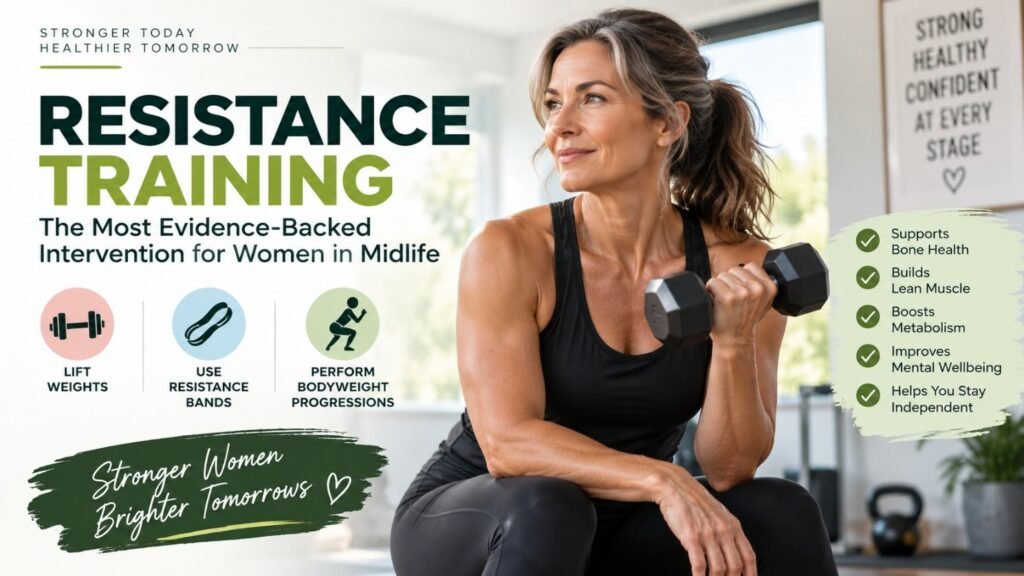
This guide explains the biology of why this is true, the specific benefits, what a starting programme looks like, and the common concerns that stop women from starting.
What Actually Changes in Your Body After 40 — and Why It Matters
Muscle Mass Declines (Sarcopenia)
From around the age of 30, adults begin to lose muscle mass at a rate of approximately three to five percent per decade. After 40 — and particularly after menopause — this rate accelerates. The medical term is sarcopenia, and it is not just a cosmetic change. Muscle is the primary driver of resting metabolic rate — the number of calories your body burns at rest. Less muscle means a slower metabolism, and a slower metabolism means that the same diet that worked in your thirties gradually stops working in your forties, not because you changed anything, but because your body composition shifted.
Sarcopenia also affects physical function. Grip strength, balance, the ability to rise from a chair without assistance, the capacity to carry groceries or climb stairs without strain — these are all functions of muscle strength. The decline is not inevitable. Resistance training is the proven intervention that builds and maintains muscle mass at any age. Women in their seventies who train consistently have measurably better muscle mass, strength, and functional capacity than sedentary women a decade younger.
Bone Density Drops — Especially Around Menopause
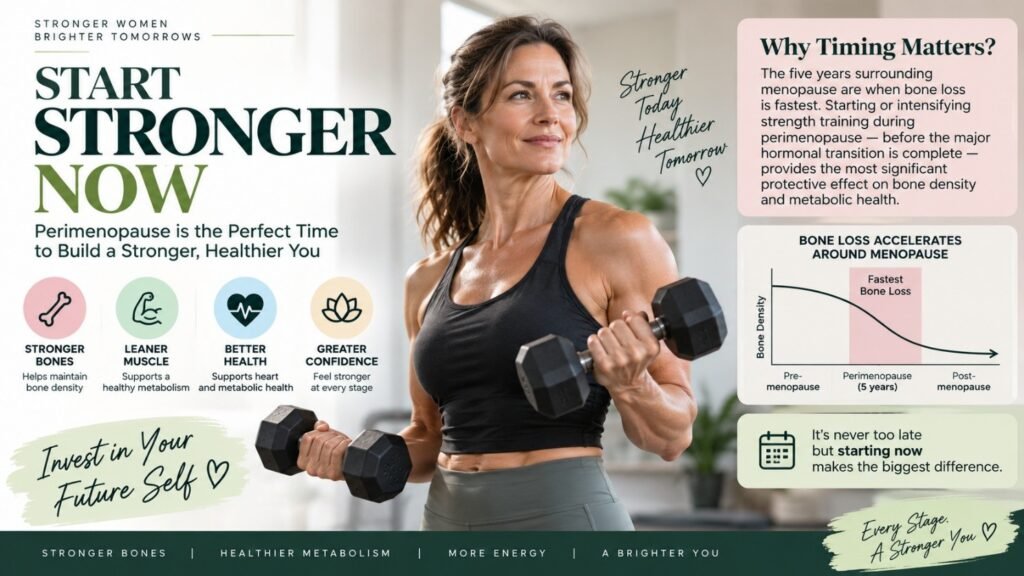
Estrogen plays a central role in maintaining bone density. During perimenopause and menopause, as estrogen levels decline, bone loss accelerates significantly — particularly in the first five years after menopause, when women can lose two to three percent of bone density per year. This is the pathway to osteoporosis and the fragility fractures that cause so much disability in older women.
Cardiovascular exercise does almost nothing for bone density. Walking is better than nothing, but the stimulus it provides to bone remodelling is minimal. Resistance training — specifically, loading the skeleton with weight — is one of the most potent osteogenic (bone-building) stimuli available without medication. The mechanical load on bones during a squat, deadlift, or overhead press signals the body to increase bone density in exactly the areas most at risk.
Metabolic and Hormonal Changes
The metabolic shifts of midlife in women are real and significant. Insulin sensitivity decreases, making it easier to store fat and harder to mobilise it. Fat distribution shifts toward the abdomen — visceral fat, which is metabolically active and associated with cardiovascular risk. Resting metabolic rate falls as muscle mass declines.
Strength training addresses each of these mechanisms directly. Muscle contraction improves insulin sensitivity independently of weight loss. Building muscle mass raises resting metabolic rate. Resistance training specifically has been shown to reduce visceral fat more effectively than cardio in several controlled studies in women over 40. These are not marginal effects — they are meaningful changes in metabolic health markers.
Why Strength Training Matters More After 40 — A Complete Picture
Here is the full evidence-backed case for why resistance training becomes the most important exercise modality for women after 40:
| Benefit | Why It Matters After 40 |
| Bone density preservation | Resistance training is the most effective non-pharmacological intervention for slowing bone loss and reducing osteoporosis risk |
| Metabolic rate support | Muscle tissue is metabolically active — more muscle mass means higher resting calorie burn, counteracting the metabolic slowdown after 40 |
| Blood sugar regulation | Muscle contraction improves insulin sensitivity — strength training reduces type 2 diabetes risk and improves glucose control |
| Cardiovascular protection | Heavy compound lifting improves cardiac output, blood pressure, and lipid profiles — cardiovascular benefits are real and substantial |
| Joint health | Strengthening the muscles around joints reduces pain, improves stability, and decreases injury risk — especially knees and hips |
| Hormonal balance | Resistance training supports healthy estrogen metabolism and is associated with reduced menopausal symptom severity |
| Mental health and cognition | Strength training reduces depression and anxiety symptoms, improves sleep, and is associated with lower dementia risk |
| Physical independence | Functional strength — the ability to lift, carry, climb, and move without assistance — determines quality of life in later decades |
The point that connects all of these benefits is that they compound. Better bone density now means lower fracture risk in your sixties. More muscle mass now means a higher metabolic rate and better glucose control in your fifties. Starting strength training at forty does not just help you at forty — it is an investment in the version of yourself that exists twenty years from now.
What About Cardio? — The Honest Answer
Cardiovascular exercise is genuinely beneficial and is not being dismissed here. Aerobic fitness is important for heart health, mental health, and longevity. The argument is not that women over 40 should stop doing cardio — it is that cardio alone is insufficient for the specific health challenges of midlife.
A woman who walks four times a week and does nothing else is better off than a sedentary woman. But she is still losing muscle mass, still losing bone density, and still experiencing the metabolic changes that resistance training directly addresses. She is working on cardiovascular fitness but not on the other biological clocks that are ticking.
The evidence-based recommendation from most major health organisations — including the American College of Sports Medicine, the British Menopause Society, and NICE in the UK — is that adults, and particularly women over 40, should include resistance training at least two times per week alongside aerobic activity. Not instead of it — alongside it.
In practice, for women who currently do only cardio and are considering adding strength training, the recommendation is not to replace the cardio. It is to add two or three thirty-to-forty-five-minute strength sessions per week to what they are already doing.
A Practical Starting Programme for Women Over 40
If you are new to strength training or returning after a significant break, here is a sensible full-body programme to do two to three times per week with at least one rest day between sessions:
| Exercise | Primary Muscles | Sets / Reps | Why It’s Included |
| Goblet squat | Legs / glutes | 2 x 10–12 | Builds lower body strength; safer for the knees than barbell squat when starting out |
| Romanian deadlift | Hamstrings / glutes | 2 x 10–12 | Posterior chain strength; excellent for bone density; teaches hip hinge movement |
| Dumbbell press | Chest / shoulders | 2 x 10–12 | Upper body pushing strength; can be done on bench or floor |
| Seated row | Back / biceps | 2 x 10–12 | Upper body pulling strength; posture support; counteracts desk-related tightness |
| Glute bridge | Glutes / lower back | 2 x 15 | Glute activation; lower back support; protects the hip joint |
| Overhead press | Shoulders / triceps | 2 x 10 | Shoulder stability and overhead strength; functional for daily life tasks |
| Plank hold | Core | 2 x 20–30 sec | Deep core stability; protects the spine; does not load the pelvic floor the way crunches do |
Start with a weight that feels challenging by the last two to three reps but allows you to maintain good form throughout. The goal in the first four to six weeks is to learn the movements correctly, not to lift as heavy as possible. Progress by adding a small amount of weight when you can complete all your sets comfortably — this is the principle of progressive overload, and it is what makes strength training produce results over time.
Common Concerns About Strength Training After 40 — Addressed
‘I’ll get bulky’
This is the most common concern and the least well-founded. Women have approximately ten to twenty times less testosterone than men — the primary hormonal driver of significant muscle hypertrophy. Getting ‘bulky’ from strength training requires a significant caloric surplus, very high training volumes, and often pharmacological assistance. What women who strength train typically experience is a change in body composition — less fat, more muscle — that makes them appear leaner and more defined, not larger.
‘I’m too old to start’
The research is clear that women can build meaningful muscle mass and strength at any age. A landmark study published in the Journal of the American Medical Association found that women in their seventies and eighties who began resistance training programmes gained significant muscle mass and functional strength. Starting at forty, fifty, or sixty is not too late. Waiting another decade, on the other hand, is a meaningful cost in bone density and muscle mass that becomes progressively harder to recover.
‘I’ll injure myself’
The injury risk from well-supervised, progressively loaded strength training is lower than most people assume — and significantly lower than the injury risk from high-impact activities like running. The key qualifications are: well-supervised (a few sessions with a qualified trainer to learn correct form) and progressively loaded (not trying to lift maximally in the first month). The injury risk from not strength training — fractures from compromised bone density, falls from weak legs, joint pain from muscle imbalance — is considerably higher.
‘I don’t know where to start’
The programme above is a legitimate starting point. Two sessions per week for the first month, learning the movements, is entirely manageable for most women. A personal trainer for even a handful of sessions to establish correct form is one of the highest-value fitness investments available — it prevents injury and significantly accelerates the learning curve.
| The Most Important Thing to Know About Strength Training and Menopause: Beginning or intensifying strength training during perimenopause — before the major hormonal transition is complete — provides the most significant protective effect on bone density and metabolic health. The five years surrounding menopause are when bone loss is fastest. Building bone-strengthening habits before and through that window is the highest-impact timing. This does not mean it is too late after menopause — it never is — but the biological case for starting now rather than later is compelling for any woman in her forties. |
Frequently Asked Questions — Women’s Fitness After 40
Why is strength training so important for women after 40?
After 40, women face three interconnected biological challenges that cardio alone does not address: accelerating muscle mass loss (sarcopenia), which slows metabolism and affects functional strength; bone density decline (which accelerates sharply around menopause); and metabolic changes including reduced insulin sensitivity and increased visceral fat accumulation. Resistance training directly targets all three — building and preserving muscle mass, providing the mechanical load that stimulates bone remodelling, and improving insulin sensitivity and metabolic function. No other single exercise modality has this breadth of evidence for the specific health challenges of midlife women.
How often should women over 40 do strength training?
The evidence-based recommendation is two to three strength training sessions per week, each session working all major muscle groups (full-body) or splitting upper and lower body across sessions. Each session needs at least 48 hours of recovery before repeating the same muscle groups. Beginners should start with two full-body sessions per week and progress to three as they build comfort with the movements. This can be alongside cardio activity — strength and cardiovascular training complement each other and should not be treated as an either/or choice.
Will strength training make women over 40 bulky?
No — the concern about bulking is not consistent with the physiology of women over 40. Women have significantly lower testosterone than men, which limits the degree of muscle hypertrophy possible without pharmaceutical assistance. Women who strength train typically see a change in body composition — reduced fat mass, increased muscle mass — that produces a leaner, more defined appearance. For women in their forties and beyond, the changes are even more moderate in terms of size and more significant in terms of functional capacity, metabolic health, and bone density.
What exercises are best for women over 40?
Compound movements — exercises that work multiple muscle groups simultaneously — provide the most comprehensive benefit for women over 40. These include squats, deadlifts, Romanian deadlifts, lunges, bench press, overhead press, and rows. Compound movements build functional strength, provide a greater bone density stimulus than isolation exercises, and are more time-efficient. Starting with dumbbells or bodyweight variations of these movements is appropriate for beginners; progression to barbells and heavier loads follows naturally as strength and form develop.
Is it safe to start weight training at 45, 50, or 55?
Yes — and the research strongly supports starting at any of these ages. Studies consistently show that women in their fifties and beyond who begin resistance training programmes gain significant muscle mass, improve bone density markers, reduce cardiovascular risk factors, and report better quality of life and functional independence. The only meaningful modifications for older beginners are to begin with lighter loads and a longer learning phase for technique, to allow slightly more recovery time between sessions, and to be attentive to any joint discomfort that warrants modification of specific movements.
Can strength training help with weight management after 40?
Yes — and it works through several mechanisms. Building muscle mass raises resting metabolic rate — the number of calories burned at rest — which tends to decline as cardio-only exercisers age and lose muscle mass. Strength training improves insulin sensitivity, which affects how efficiently the body processes carbohydrates and stores or mobilises fat. Research comparing strength training to cardio for body composition in women over 40 consistently shows that resistance training produces greater reductions in body fat percentage and visceral fat, even when total calorie burn during sessions is lower than equivalent cardio.
The Investment That Pays Off for Decades
Women’s strength training after 40 is not a trend, a temporary programme, or a fitness phase. It is the most evidence-backed thing a woman can do for her long-term health, independence, and quality of life. The bones you build now are the bones that protect you in your sixties. The muscle you maintain now is the muscle that keeps you mobile, metabolically healthy, and functionally strong in your seventies.
The barrier to entry is lower than most women expect. You do not need a gym membership, a barbell, or a programme you found on social media. You need two to three sessions per week, movements that progressively load your major muscle groups, and enough consistency to let the adaptation happen over months rather than days.
The best time to start was ten years ago. The second best time is now. Pick up the weight.
This article is for informational and educational purposes only. Individual fitness needs vary based on health status, fitness level, and medical history. Consult a healthcare professional before beginning a new exercise programme, particularly if you have existing health conditions, bone density concerns, or joint issues.Keywords: women’s fitness after 40 · strength training for women over 40 · women over 40 workout · weight training women 40s · fitness over 40 female · best exercise for women over 40 · sarcopenia women · bone density exercise · menopause